

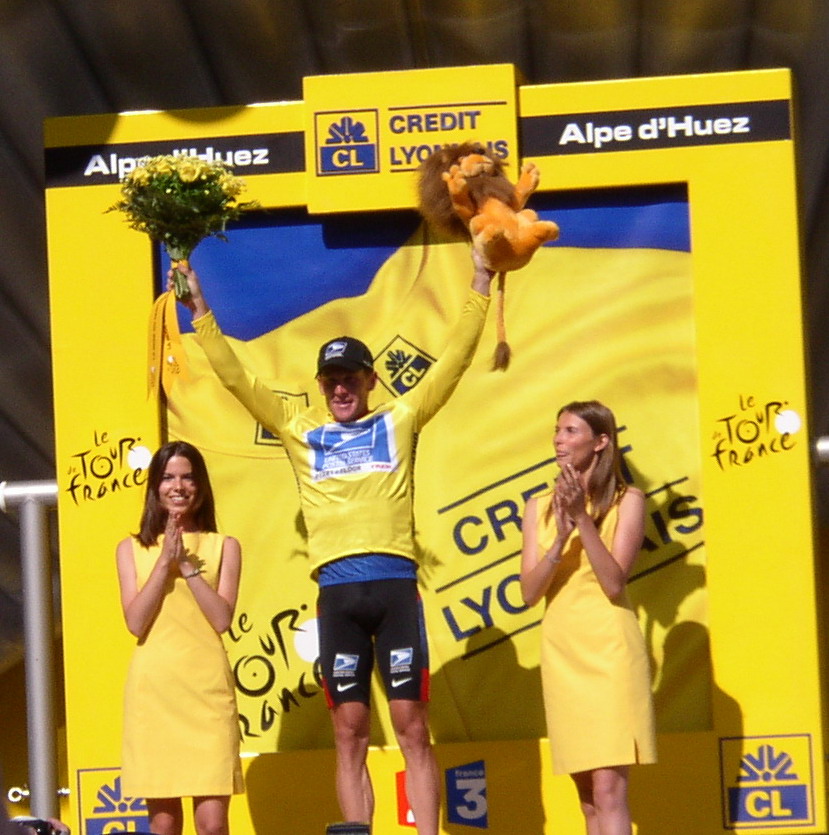
Every July in the 1990s, the world's most gruelling race broadcast a consistent image across hundreds of millions of television screens: riders grinding through Alpine passes, yellow jerseys catching the high-altitude sun, and Oakley sunglasses on nearly every face at the front of the peloton. No sponsorship deal forced it. The frames simply worked.
The relationship between Oakley and professional cycling during that decade was more than a brand alignment. It was proof of concept. When the fastest, fittest athletes on the planet chose your eyewear for a race lasting three weeks across mountains and time trials, the quality argument made itself.
"When the fastest athletes on the planet chose your eyewear for the Tour de France, the quality argument made itself."
Context
What Pro Cyclists Were Wearing Before Oakley Changed Everything
Before Oakley arrived as a serious sport optics player in the late 1980s, elite road cyclists had limited options. Basic wraparound frames from European manufacturers, sometimes little more than tinted lenses with wire rims, were the standard. They offered minimal wind protection, no impact resistance, and the kind of aesthetic you would expect from equipment designed without input from athletes who actually used it.
Oakley's entry into the cycling market changed the brief entirely. The O Matter frame material reduced weight while improving fit under sustained physical load. The Plutonite lens, manufactured from a single piece of polycarbonate, blocked 100% of UVA, UVB, and UVC radiation, a meaningful benefit for riders spending six or more hours a day at altitude. By the early 1990s, serious competitors were not choosing Oakley because they had to. They were choosing them because nothing else performed at the same level.
Collector Verdict
The racing pedigree of early Oakley sport frames is the technical story behind why these lenses still outperform most of what is available new today.
The Models
Eye Jacket, M Frame, and the Lenses That Crossed the Alps
The Eye Jacket became one of the defining frames of 1990s professional cycling. Its semi-rimless construction and replaceable lens system made it practical for stage racing, where light conditions changed dramatically from the Pyrenees to the coastal time trials. Riders could swap lenses between stages without replacing the entire frame, a genuine performance advantage that collectors now recognise as the beginning of Oakley's modular eyewear philosophy.
The M Frame ran alongside it, favoured for its aggressive wraparound geometry and superior peripheral coverage. Its single-piece shield lens created a more unified field of vision at speed, and the frame's construction gave it a durability that matched the demands of three weeks of racing. Both models were produced in colourways specifically engineered for high-altitude light: Iridium coatings to cut glare on snow and road surfaces, Fire Iridium for low-angle morning sun, and Black Iridium for overcast Alpine stages.
Collector Verdict
Eye Jacket and M Frame units in cycling-specific colourways, particularly Iridium and Fire lenses, are the most direct physical link to Tour racing from this era. Clean examples with original lenses command consistent premiums.
Cultural Impact
How Three Weeks of Racing Sold a Decade of Oakley to the World
The Tour de France's television audience in the 1990s was enormous. Across Europe, the race attracted viewership figures that rivalled any sporting event on the calendar. For three weeks every July, Oakley frames appeared on screen in close-up, worn by the best-conditioned athletes alive, in some of the most dramatic landscapes on the continent. The effect on brand recognition was immense, and it was entirely organic.
Unlike football or tennis, where product placement is negotiated and staged, Oakley's Tour presence came from genuine performance adoption. Riders wore them because they worked. That authenticity translated directly into consumer demand, particularly in Australia and the United States, where the Tour was gaining its first serious television audiences. For a generation of teenage cyclists in the 1990s, Oakley frames were not just sunglasses. They were the visible proof that you took the sport seriously.
Smart Buy Alert
First-generation Eye Jacket and M Frame units in cycling colourways are currently undervalued relative to the X-Metal series. Collectors focused on provenance and history are buying them quietly.
Collector Guide
Why Tour-Era Oakley Frames Hold Their Value Differently
Frames associated with Tour de France-era racing carry a different weight in the collector market than purely aesthetic pieces. The performance pedigree is documented. The colourway choices were engineered for specific light conditions, not marketing briefs. And the production windows are known and finite: these frames were made during a specific period, for a specific purpose, and Oakley has never returned to that exact design philosophy.
What collectors should track are complete sets: frame, original lenses, and case from the 1992 to 1999 production years. The earliest Eye Jacket iterations and M Frame variants in Iridium are the benchmark. Condition matters considerably here. The O Matter material ages predictably, but sun exposure and storage conditions accelerate degradation. A genuine A-grade example with original lenses intact is a meaningful find, and increasingly rare as the collector market matures.
Collector Verdict
Tour-era Oakley frames in verified original condition are historical artefacts as much as eyewear. The market recognises this slowly, which means the current window for acquisition at reasonable prices is narrowing.
The Vault
Find One in the Vault
VaultShades sources authenticated vintage Oakley from the Tour-era and beyond. Every frame is graded, verified, and shipped from Australia. If you're building a serious collection, this is where to start.
Browse the Current Drop